BEFORE YOU DEPART –
ANY QUESTIONS? WE’VE GOT ANSWERS!

How can I find a travel clinic near me?
Before your next trip, it’s important to have a strong plan of action, and we’ve got you covered.
Click here and enter your postal code to find a list of travel clinics near you.
How does IXCHIQ® work?
IXCHIQ® works by stimulating your immune system to make substances known as antibodies which fight the chikungunya virus. Once vaccinated, if a person comes into contact with chikungunya virus, their body can fight off the virus.
How is IXCHIQ® administered?
IXCHIQ® is given by a healthcare professional as a single injection in the upper arm muscle in individuals 12 years of age and older.
When should I take IXCHIQ®?
Since it usually takes two to four weeks to help protect you against the chikungunya virus following vaccination, ask your healthcare professional about IXCHIQ® at least 4 weeks before your trip.
What are the ingredients in IXCHIQ®?
Medicinal ingredients: Purified live-attenuated chikungunya virus.
Non-medicinal ingredients: D-Sorbitol, L-Methionine, Magnesium Chloride, Potassium phosphate, Recombinant Human Albumin (rHA), Sucrose, Trisodium citrate di-hydrate.
What should I mention to my healthcare professional before taking IXCHIQ®?
To help avoid side effects and ensure proper use, talk to your healthcare professional about any health conditions or problems you may have, including if you:
- have any conditions impacting your overall fitness, and the stability of these conditions
- have a weakened immune system, for example, due to a genetic defect, HIV infection, or certain medications such as cancer treatment
- have a bleeding disorder or a reduction in blood platelets, which increases risk of bleeding or bruising (thrombocytopenia) and cannot receive injections in the arm
- currently have any illness with a fever of more than 38.0°C
- have had an allergic reaction to a component of IXCHIQ®
- take any medicines, even those you can buy over the counter
What are the serious warnings and precautions of IXCHIQ®?
- Available post-marketing data suggest that individuals 65 years of age and older who are medically frail with multiple chronic medical conditions may have an increased risk for serious adverse reactions following recent vaccination with IXCHIQ®
- Severe reactogenicity or chikungunya-like adverse reactions may lead to a worsening of the general condition including a general feeling of discomfort and decreased appetite, worsening of preexisting diseases, confusional state, encephalopathy (disturbance of brain function), or encephalitis (inflammation of the brain), leading to falls, hospitalisation and death. Vaccinees should promptly seek medical attention if they experience, after vaccination, symptoms suggestive of severe reactogenicity or severe chikungunya-like adverse reactions.
- For cases received post-marketing indicative of chikungunya-like adverse reactions, the most frequent symptoms reported in combination with fever were headache (51% of reports), arthralgia (41%), fatigue (38%) and myalgia (35%), pain (19%) and chills (19%). This mostly aligns with findings from clinical trials, with no notable differences observed.
- As with all injectable vaccines, appropriate medical treatment and supervision should always be available to treat possible anaphylactic reactions following the administration of the vaccine.
- IXCHIQ® must never be injected into a vein or any blood vessel.
- As with any other vaccine, vaccination with IXCHIQ® may not result in protection in all people.
- Like other intramuscular injections, this vaccine should not be administered to persons with thrombocytopenia, hemophilia or other bleeding disorders.
- People with a medically-confirmed weak immune system (immunodeficiency) or taking medicines that can undermine the immune system (e.g., high-dose corticosteroids, drugs for rheumatoid arthritis or cancer drugs), IXCHIQ® should not be given as it is a live vaccine.
What are the areas at-risk of chikungunya?
The chikungunya virus has become more frequent and widespread across Asia, Africa, Europe and the Americas.
The chikungunya virus has been reported in 119 countries and territories (prior to 2025).
What kind of vaccine is IXCHIQ®?
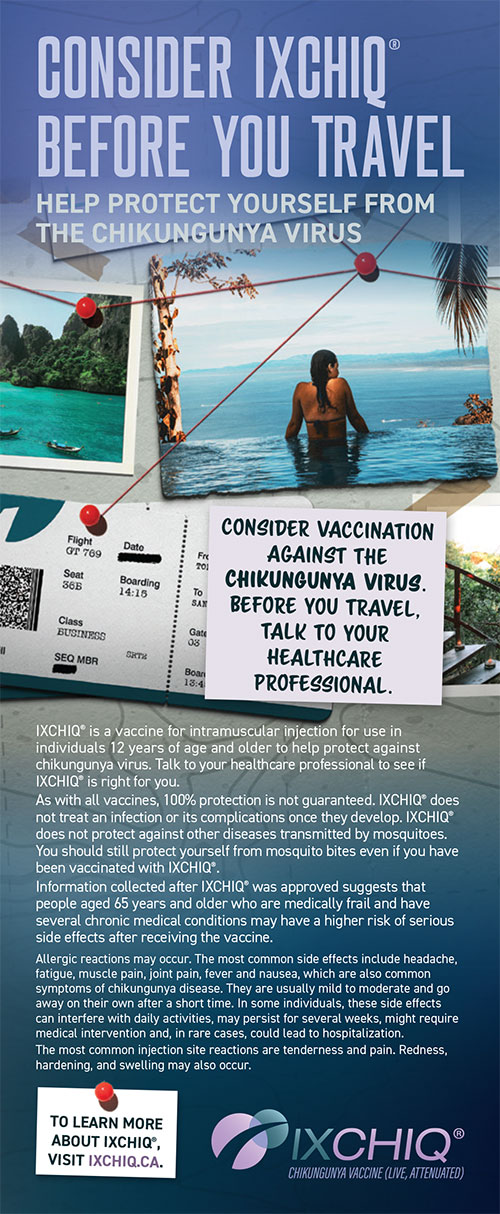
IXCHIQ® is a live-attenuated vaccine for intramuscular injection for use in individuals 12 years of age and older to help protect against chikungunya virus.
Being a live-attenuated vaccine means IXCHIQ® contains a weakened (or attenuated) form of the virus. Because the vaccine is so similar to the natural infection, it helps to prevent chikungunya disease.
Immunity after infection with the chikungunya virus is thought to convey lifelong immunity. It hasn’t yet been established if a booster dose is required following immunization with IXCHIQ®.
You should consult your healthcare professional on the duration of protection of IXCHIQ® prior to potential re-exposure to the chikungunya virus.
After I get one dose of IXCHIQ®, do I need a booster dose if I ever travel again?
To learn more about the duration of protection IXCHIQ® provides, you should consult your healthcare professional prior to potential re-exposure to the chikungunya virus.
Who should not take IXCHIQ®?
You should not take IXCHIQ® if you:
- have or if it is suspected that you have an immunodeficiency or immunosuppression (e.g., from malignancies such as cancers arising from abnormal blood or bone marrow cells and solid tumors, recent chemotherapy, immunodeficiency from birth, long-term immunosuppressive therapy for chronic conditions such as autoimmune disorders or organ transplants, or HIV infection with immunocompromised state)
- are allergic to any of the ingredients in the vaccine
- are pregnant. Women of child-bearing potential avoid pregnancy for one month following vaccination.
Can IXCHIQ® cause any side effects?
The most common side effects of IXCHIQ® are headache, fatigue, muscle pain, joint pain, fever and nausea, which are also common symptoms of chikungunya disease. They are usually mild to moderate and go away on their own after a short time. In some individuals, these side effects can interfere with daily activities, may persist for several weeks, might require medical intervention and, in rare cases, could lead to hospitalization.
The most common injection site reactions are tenderness and pain. Redness, hardening, and swelling may also occur. In addition, the following rare serious side effects may occur.
Potential rare serious side effects include difficulty breathing, hoarseness or wheezing, hives, dizziness, weakness or fast heartbeat.
Some people who have received IXCHIQ® have experienced rare serious side effects similar to complications that can occur with chikungunya virus, including:
- Atrial Flutter (abnormal heart rate)
- Rapid heart rate
- Aseptic meningitis (inflammation of the membranes covering the brain and spinal cord that is not due to a bacterial infection)
- Encephalopathy (brain dysfunction with symptoms such as confusion and impaired memory)
- Encephalitis (inflammation of brain tissue) that resulted in death
People 65 years of age and older who are medically frail with multiple chronic (long-term) unstable medical conditions might have an increased risk for these types of serious side effects after receiving IXCHIQ®.
You should see a healthcare professional without delay if you experience any of the potential serious side effects above.
These are not all the possible side effects you may have when taking IXCHIQ®. If you have troublesome symptom or side effect that is not listed here or becomes bad enough to interfere with your daily activities, tell your healthcare professional.